
Mumbai, 30 September 2026. munotes has finished its notes for Semester 1 of B.Sc. (Computer Science), for students of Mumbai University and its affiliated colleges. Every paper on the Semester 1 scheme now has a complete book, written to the revised NEP 2020 syllabus in force since 2024-25:
- Digital System and Architecture
- Fundamentals of Database Systems
- Computer Science Practical 1
- Introduction to Programming with Python
- Statistics with R Programming
- LINUX Operating System
Together the six books run to 489 chapters and 1,895 pages. Nothing in them was typed from memory. The programs, database queries, LINUX commands and circuits were run before they were printed, and the output under each one is the output the computer gave.
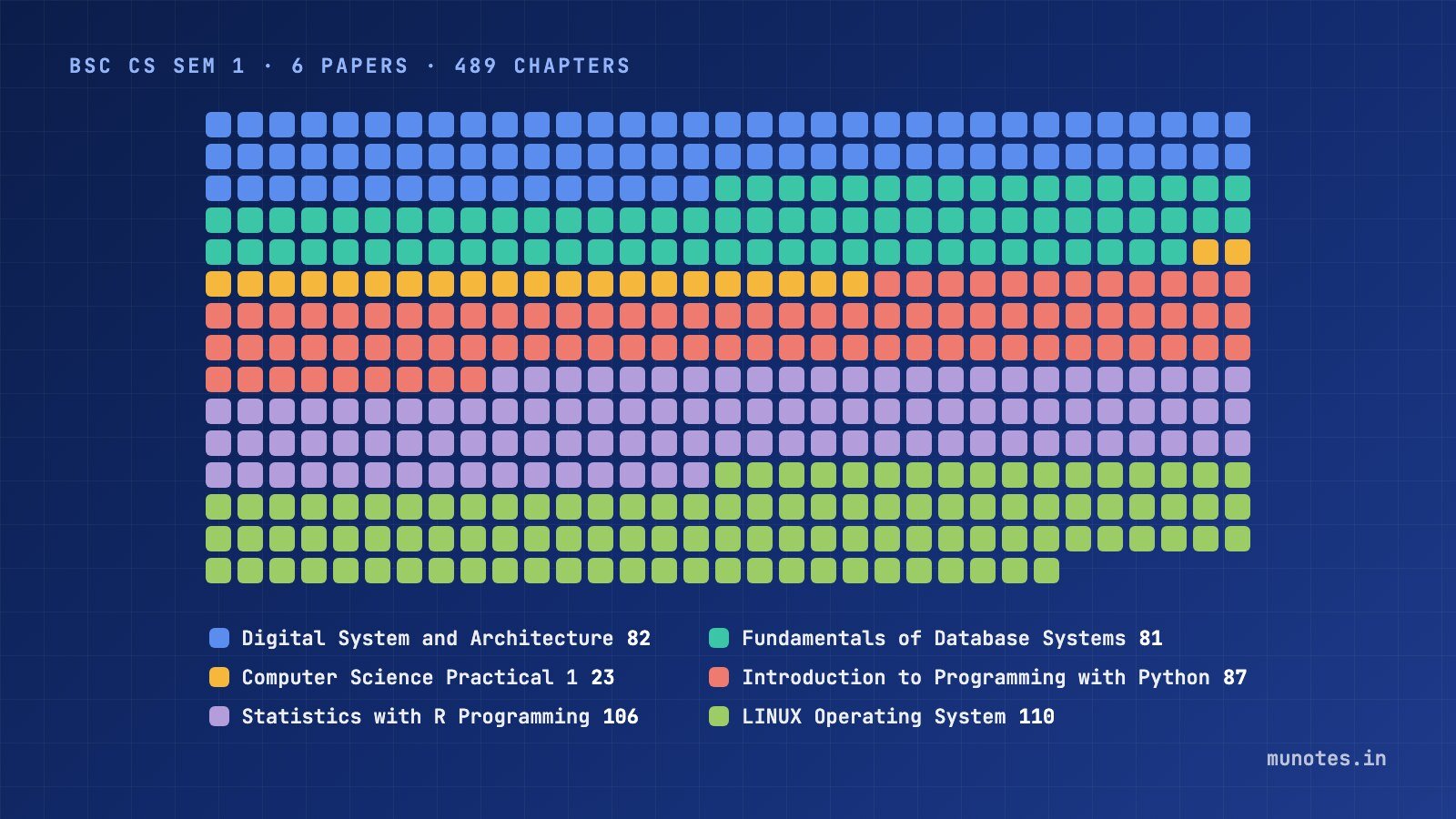
One square per chapter, 489 in all. LINUX Operating System 110, Statistics with R Programming 106, Introduction to Programming with Python 87, Digital System and Architecture 82, Fundamentals of Database Systems 81, Computer Science Practical 1 23.
"A first-year student copies what the notes print, into the journal and into the exam," said the munotes editorial desk. "If a book prints an output the computer would never give, the student is the one who loses the marks. So we ran the code first, and copied the answers from the machine."
The short version
- All six Semester 1 papers are complete. 489 chapters and 1,895 pages, with every module of every book published.
- Written to the current syllabus. This is the revised NEP 2020 syllabus for B.Sc. (Computer Science), Item No. 6.5 (R), approved by the University's Academic Council on 12 July 2024 and in force from 2024-25. On 28 September 2026 we checked again: no newer syllabus has been issued.
- Three of the five papers you sit from this list are practical exams. Python, your skill course (R or LINUX) and Computer Science Practical 1 are each a 2 hour exam at a computer with a viva, and you need a certified journal to sit them. The books are built for that.
- Checked by running, not by reading. 476 SQL examples run on MySQL, the Python programs run on three versions of Python, the R code run in R, the LINUX commands run on Ubuntu, and the circuits run in Logisim, the simulator your practical uses.
- R or LINUX: both are here. The University lists Statistics with R Programming and LINUX Operating System as alternatives, and you take one. Both books are complete.
- Start reading now. Module I of every book opens without an account, on your phone or your laptop.
The six papers, one by one
Digital System and Architecture
Major paper, examined in writing. A 1 hour theory exam for 30 marks: three questions, and in each you answer any 2 of 4. Question 1 is on Module 1, Question 2 on Module 2, and Question 3 on both. The other 20 marks come from class tests and assignments in college.
Module 1 covers Boolean algebra, logic gates, Karnaugh maps, combinational circuits such as adders and multiplexers, flip-flops and counters, and how the parts of a computer fit together. Module 2 covers memory, cache and virtual memory, instructions, and how a processor is organised. 279 Boolean equations were checked against every row of their truth tables, the circuits were built and run in Logisim, and all 26 programs for the 8085 microprocessor were run on a simulator. 82 chapters, 339 pages.
Open the Digital System and Architecture notes
Fundamentals of Database Systems
Major paper, examined in writing. The same pattern: a 1 hour theory exam for 30 marks, three questions of any 2 of 4, and 20 internal marks.
Module 1 covers what a database system is, data models, entity relationship design and how to turn it into tables, and the SQL that creates tables and changes data. Module 2 covers the relational model and its constraints, SQL functions, joins and subqueries, normal forms, protecting a database, views, and giving and taking back access. The book also carries this paper's practical module, the half of Computer Science Practical 1 that is done in MySQL. All 476 SQL examples in it were run on a MySQL server, and the result printed under each one is the result the server returned. 81 chapters, 319 pages.
Open the Fundamentals of Database Systems notes
Computer Science Practical 1
Practical paper. A 2 hour exam at a computer for 30 marks: a practical question on Digital System and Architecture for 12, one on Fundamentals of Database Systems for 12, and a viva for 6. The other 20 marks come from your practicals and their write-ups during the semester, and you cannot sit the exam without a certified journal.
Module 1 is the circuit practicals in Logisim: logic gates, Boolean simplification, adders and subtractors, a magnitude comparator, flip-flops, counters, a shift register, and multiplexers and demultiplexers. Module 2 is the database practicals in MySQL: ER design, creating and changing tables, queries and functions, joins, subqueries, normalisation, views and access control. The combinational circuits were run in Logisim on every input they can take, and all 140 SQL blocks were run on MySQL, with the printed output matching the server's. The book opens with how the practical is examined: the journal, the write-up and the viva. 23 chapters, 113 pages.
Open the Computer Science Practical 1 notes
Introduction to Programming with Python
Practical paper, no written exam. MU prints this paper's type as Practical. The exam is 2 hours at a computer for 30 marks: a practical question on Module 1 for 12, one on Module 2 for 12, and a viva for 6. The other 20 marks come from practical tasks and their write-ups, and a certified journal is compulsory.
Module 1 covers the basic elements of Python, operators and control statements, arrays, functions and strings. Module 2 covers lists, tuples and dictionaries, files, regular expressions, and dates and times. Every technique comes with a complete program, and the last chapter of each module is that module's set of practicals, written the way a journal wants them. The programs were run on three versions of Python (3.12, 3.13 and 3.14), and each had to print the same output on all three. 87 chapters, 389 pages.
Open the Introduction to Programming with Python notes
Statistics with R Programming
Skill course, practical, no written exam. The same practical exam: 2 hours for 30 marks (12, 12, and a viva for 6), 20 internal marks from practical sessions and their write-ups, and a certified journal to sit the exam.
Module 1 covers setting up R, RStudio and R Commander, expressions, decisions and loops, vectors, matrices, arrays and lists, and strings. Module 2 covers R's statistical functions, linear and multiple regression, the normal and binomial distributions, time series, and drawing and reading graphs. Each module ends with practical sessions in journal form (aim, theory, code, output, conclusion) and a chapter of viva questions. The R code was run in R 4.6.1, and the output and the 79 figures you see are what R produced. 106 chapters, 346 pages.
Open the Statistics with R Programming notes
LINUX Operating System
Skill course, practical, no written exam. The alternative to Statistics with R Programming, examined the same way: 2 hours at a computer for 30 marks (12, 12, and a viva for 6), 20 internal marks, and a certified journal to sit the exam.
Module 1 covers where Linux comes from, installing Ubuntu, everyday use as a power user, the file system, file handling, utility commands and file permissions. Module 2 covers security (root, sudo, passwords and ssh), networking commands, the vi, sed and awk editors, filters and redirection, shell scripting, processes, and scheduling jobs. A third part covers the journal and the practical exam. The commands were run on Ubuntu 24.04, and the output under each one is what that machine printed. The few that need a person at the keyboard, such as vi and the installer screens, are marked as such. 110 chapters, 389 pages.
Open the LINUX Operating System notes
Why the examples were run, not proof-read
Notes for a computing subject go wrong in a particular way. A program is copied from somewhere, its output is written from memory, and nobody runs it. The student types it into the journal, gets a different answer in the lab, and no longer knows which one to trust.
So these six books follow one rule: if a computer can run it, a computer ran it, and the page shows what the computer printed. When a run disagreed with the draft, the draft was changed, not the output. Every topic MU prints for these papers is covered, and a script checks that none was missed.
Where to start
All six books are on one page, with what each one covers: B.Sc. (Computer Science) Semester 1 notes.
Or go straight to a book:
- Digital System and Architecture, 82 chapters
- Fundamentals of Database Systems, 81 chapters
- Computer Science Practical 1, 23 chapters
- Introduction to Programming with Python, 87 chapters
- Statistics with R Programming, 106 chapters
- LINUX Operating System, 110 chapters
To check the syllabus these books follow, the Semester 1 syllabus is on munotes too, paper by paper.
Questions students ask
Are these notes for the old syllabus or the new one?
The new one. They follow the revised NEP 2020 syllabus, Item No. 6.5 (R), approved on 12 July 2024 and in force from 2024-25. A lot of material online is still written for the older syllabus, whose papers had different names. If your syllabus lists Fundamentals of Database Systems, Introduction to Programming with Python, and Statistics with R Programming or LINUX Operating System, you are on the syllabus these books follow.
I take Statistics with R. Do I need the LINUX book?
No. The University lists the two as alternatives, and you sit one. Both books are complete, so whichever one your college offers is covered.
Is Python a written exam?
No. MU prints its type as Practical: a 2 hour exam at a computer for 30 marks, including a 6 mark viva, plus 20 internal marks from practical tasks. You need a certified journal to sit it. The same is true of Statistics with R Programming, LINUX Operating System and Computer Science Practical 1.
Can I download the notes as a PDF?
No. The books are read on munotes.in, on a phone or a laptop. They are not PDF files, and that is deliberate: when a mistake is corrected, every reader sees the corrected page, not an old copy saved before the fix.
What if I find a mistake?
Every chapter page has a Report or request button. It opens an email to us with the page already named, so we know exactly where to look.
Also on munotes for B.Sc. (Computer Science)
Semester 1 is the first semester of the degree to be complete. These books from later semesters are finished too:
- Semester 3: Principles of Operating Systems
- Semester 3: Theory of Computation
- Semester 3: Computer Science Practical 3
- Semester 5: Artificial Intelligence
- Semester 5: IKS in Computational Systems
- Semester 5: Computer Science Practical 5
About munotes
munotes (munotes.in) is an independent study website for students of Mumbai University and its affiliated colleges. It publishes syllabus pages, previous year question papers, and notes written to the current syllabus, for law, commerce and now computer science. munotes is not affiliated with, endorsed by, or officially connected to the University of Mumbai.
For corrections and questions, write to us through the contact page.